Intelligent Octopus Flux: the misunderstood tariff
Why Intelligent Octopus Flux can look better than it is, when matched import and export rates help, and what solar battery homes should check.
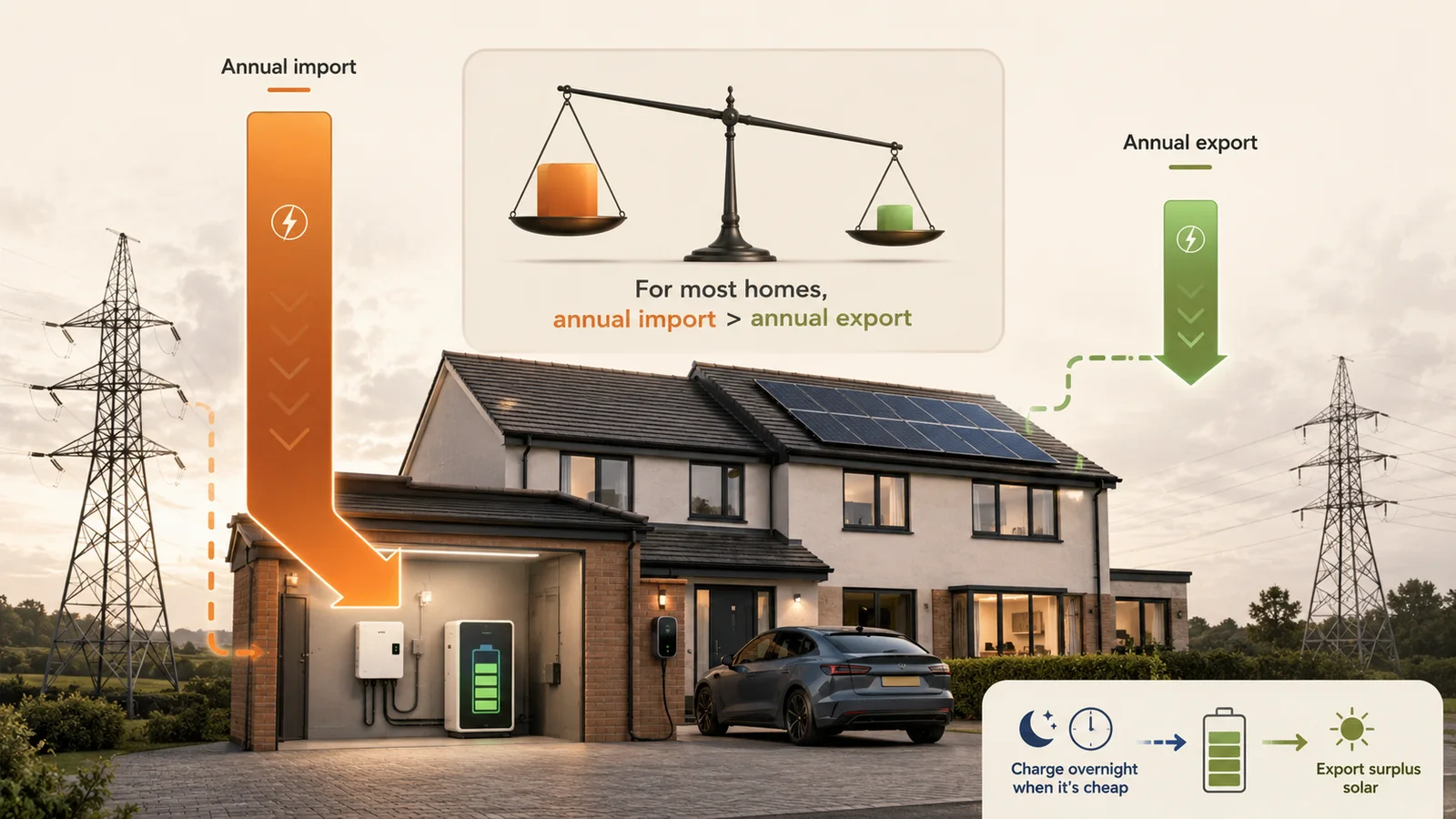
Intelligent Octopus Flux is easy to misunderstand because the headline export rate looks attractive. The problem is that export is only one side of the bill.
On Intelligent Octopus Flux, the import and export unit rates match. That means the evening peak can pay well when your battery exports, but the same peak can also be expensive if your home imports.
The question is not "is Intelligent Octopus Flux good or bad?" The better question is: does your home export more value than it imports, after standing charge, battery losses, winter usage and control limits?
Intelligent Octopus Flux makes the most sense when your home is a strong net exporter. If your annual import is higher than your export, the tariff deserves a careful check before you switch.
The quick version: Intelligent Octopus Flux is misunderstood
- Octopus says Intelligent Octopus Flux pairs with a compatible battery and schedules charging and discharging for you.
- Octopus's FAQ says Intelligent Octopus Flux has matched import and export rates. The high 16:00 to 19:00 export period also has a high import period.
- The tariff can work well for homes with a compatible battery, large solar generation, enough storage, a useful export limit, and annual export value that is clearly higher than annual import cost.
- It can look much worse for homes where annual import is higher than annual export. That is common for ordinary households once winter use, EV charging, heat pump demand and evening use are included.
- A solar and battery home should compare Intelligent Octopus Flux against options such as Intelligent Octopus Go plus Outgoing Octopus, Octopus Go plus Outgoing Octopus, Agile, or another fixed import/export setup.
- The simple test is this: your export rate should be higher than your import rate, or your cheap off-peak import rate should be well below your export rate.
What people miss about Intelligent Octopus Flux rates
Many homeowners search for "Intelligent Octopus Flux rates" and focus on the peak export number.
That is understandable. Exporting from a battery between 16:00 and 19:00 sounds attractive, especially if you already have solar panels and a battery sitting in the garage.
But the matched-rate design is the detail that matters. Octopus's FAQ says Intelligent Octopus Flux is a smart time-of-use tariff where import and export rates always match. During the peak period, customers can benefit from a high export rate, but the importing rate is also high.
That is not automatically wrong. It simply means the tariff rewards a particular type of home: one that can avoid importing expensive units and export enough energy at useful times.
A current rate example, checked against Octopus data
Rates change by region and over time, so do not plan from any old screenshot.
As a South East electricity region example checked against the official Octopus tariff API on 10 June 2026, Intelligent Octopus Flux import showed roughly 21.15p/kWh outside the peak period and 28.20p/kWh during 16:00 to 19:00. Octopus says the export rates match on Intelligent Flux.
For comparison, the same Octopus API region showed Intelligent Octopus Go off-peak import around 8p/kWh and Octopus Go off-peak import around 9.5p/kWh. The Outgoing Octopus page advertised 12p/kWh for exported units.
That comparison is why a high export headline is not enough. A home importing cheap overnight electricity at 8p and exporting surplus solar at 12p has a different shape from a home importing and exporting at matched rates around the same level.
A simple annual example: why Flux can cost more
Imagine a solar and battery home that needs roughly 13.5 kWh per day from the grid across the year. That is about 4,900 kWh of annual import.
Now imagine the same home exports about 3,500 kWh of surplus solar across the year.
Before standing charges, battery losses and exact half-hourly timing, the broad comparison looks like this:
| Tariff shape | Import cost | Export credit | Rough net energy position |
|---|---|---|---|
| Intelligent Flux-style matched rate at about 21p import/export | 4,900 kWh x 21p = about £1,030 | 3,500 kWh x 21p = about £735 | about £295 to pay |
| Intelligent Octopus Go plus Outgoing-style spread | 4,900 kWh x 8p = about £392 | 3,500 kWh x 12p = about £420 | about £28 credit |
That is the misunderstanding in one table. With the matched-rate route, the home is still paying the higher rate on more imported units than it exports. With the cheap-off-peak-plus-export route, the home is buying the energy it needs at a lower rate and selling surplus solar at a higher rate.
This example is deliberately simple. Real bills depend on region, standing charge, battery losses, how much import actually happens off-peak, and how much export happens during high-value periods. But the direction is important: if your annual import is higher than your annual export, Flux has to overcome that imbalance.
For Intelligent Octopus Flux or Octopus Flux to make clear financial sense, your export normally needs to be much higher than your import, not just close to it. That is more likely with a larger solar array, larger usable battery storage, a good export limit, or a three-phase home that can export more power.
Why your annual import and export balance matters
The rough bill logic is simple:
- if you import more kWh than you export, your import rate matters more;
- if you export more kWh than you import, your export rate matters more;
- if import and export are close, the standing charge and timing decide more of the outcome;
- if your export rate is higher than your cheap import rate, a battery can help capture that spread where supported.
The actual bill is half-hourly, so the exact answer depends on when you import and when you export. But the annual balance is still the first sanity check.
If your home imports 3,000 kWh a year and exports 1,500 kWh, a matched import/export tariff has to work very hard to beat a setup where you buy cheap overnight electricity and sell surplus solar at a higher flat export rate.
If your home imports 1,500 kWh and exports 3,000 kWh, Intelligent Octopus Flux becomes more interesting because the export side is large enough to carry the economics.
That is why the tariff can suit some larger solar and battery homes, especially homes with more roof space, three-phase supply, a high agreed export limit, or low daytime consumption. It does not mean it suits every solar battery home.
When Intelligent Octopus Flux can make sense
Intelligent Octopus Flux is worth checking when most of these are true:
- your battery brand passes Octopus's live eligibility check;
- your home exports a lot across the year, not just on a few sunny days;
- your battery is large enough to support evening export without leaving the home exposed;
- your DNO export limit lets you export meaningful power;
- your winter import is not so high that it wipes out summer export gains;
- you are comfortable with Octopus controlling the battery schedule;
- you have independent visibility of import, export, battery charge, discharge and tariff periods.
The setup is more likely to suit homes that are genuinely export-heavy. A small battery, modest solar array, low export limit and high evening import is a harder fit.
The key phrase is genuinely export-heavy. If your import and export are roughly equal, Flux may still not be the strongest route because standing charges, battery losses and any expensive peak import can eat the benefit. If your export is much higher than your import, the maths becomes more favourable.
If you are still checking eligibility, compatibility and control handover, use Intelligent Octopus Flux: what battery owners should check before doing the rate comparison.
When Octopus Go or Intelligent Octopus Go may be better
For many solar and battery homes, the cleaner structure is a cheap overnight import tariff plus a separate export tariff.
For example, Intelligent Octopus Go gives eligible EV homes a cheap overnight import window. Octopus Go has a shorter cheap window, but still gives the home a lower off-peak rate than a standard daytime tariff. Pairing either route with Outgoing Octopus, where eligible, can mean the home buys overnight energy cheaply and exports surplus solar at a higher rate.
Other suppliers can also matter in the comparison. For example, E.ON Next's Smart Export Guarantee page lists fixed export tariffs with eligibility conditions, including higher rates for customers who meet specific installation or import-tariff rules. The point is not that one supplier is always best; it is that export rate, import rate and eligibility have to be checked together.
That does not make Octopus Go or Intelligent Octopus Go automatically better. The daytime import rate can be high, and eligibility matters. It does mean the tariff comparison is clearer:
- What do you pay overnight?
- What do you get for export?
- How much can your battery cover during peak hours?
- How much import remains outside the cheap window?
If the battery can cover the home through expensive periods, the off-peak rate becomes the important import rate. If that off-peak rate is lower than the export rate, the home is in a stronger position than a matched-rate tariff where import and export are similar.
Officially, Intelligent Octopus Go is an EV tariff and depends on compatible EV or charger eligibility. Octopus Go is also presented by Octopus as an EV charging tariff. Some solar battery customers report being able to discuss Octopus Go with their supplier even when the main use case is battery charging, but that is not something to assume. Ask the supplier directly and get the eligibility confirmed before building your plan around it.
This is the same tariff-choice problem covered in Octopus Go vs Intelligent Octopus Go for battery homes and Octopus Intelligent Go: what happens to your battery.
What about Agile for solar and battery homes?
Agile is the other route people often consider because import prices move every half hour.
Agile can be useful when the home can shift load, charge the battery in cheap periods and avoid expensive periods. It can also be stressful if you do not want to keep watching prices or if your battery control is manual.
For Solis homes, the practical setup is covered in running a Solis inverter on Octopus Agile with 1app.energy. The same principle applies: the tariff is only useful when the battery follows the tariff.
The tariff test solar battery owners should use
Before choosing Intelligent Octopus Flux, Octopus Go, Intelligent Octopus Go, Agile or a flat export tariff, write down these numbers:
- Annual import kWh. Pull this from your supplier account if you can.
- Annual export kWh. Do not guess from solar generation. Export is what leaves the home after self-consumption and battery charging.
- Off-peak import rate. This is the price you pay to charge the battery from the grid.
- Export rate. This is what you are paid for surplus solar or planned battery export.
- Peak import exposure. How often does your home still import between 16:00 and 19:00?
- Battery losses. A battery is not 100% efficient, so buying energy to export later needs a real spread.
- Export limit. A high export rate is less useful if your export power is capped low.
- Control ownership. Decide whether Octopus, your inverter, or 1app.energy should be the system making decisions.
The useful rule is simple: if you are buying electricity at one rate and selling at another, the sell rate needs to beat the buy rate by enough to cover losses, standing charge context and inconvenience.
That is why a cheap off-peak import rate plus a flat export rate can be attractive. If you can charge at 8p and export surplus at 12p, the spread is easy to understand. If import and export match, the home needs enough export volume and good timing for the tariff to work.
The export-limit part matters more than many tariff comparisons admit; home battery export checks before selling stored energy explains the DNO and inverter side.
How 1app.energy fits into this decision
1app.energy exists because the tariff is only half the problem. The other half is making the battery, solar, EV charger and tariff behave as one system.
For supported Solis, Zappi and Octopus homes, with LuxPowerTek in beta, 1app.energy gives the customer one view of tariff windows, battery behaviour, solar generation and EV charging. Where supported, verified and customer-enabled, Smart Control can charge the battery during cheaper windows, protect the home from expensive periods and help coordinate export opportunities.
That is useful whether the home chooses Go, Intelligent Octopus Go, Agile, a fixed import tariff with a separate export tariff, or another route that needs battery coordination.
It is not a promise of profit. It is a way to stop the home wasting the tariff spread it already has.
Common questions about Intelligent Octopus Flux
Is Intelligent Octopus Flux worth it?
It can be, but mainly for homes where the export side is strong enough. Check annual import, annual export, battery size, export limit and whether you are happy with Octopus controlling the battery.
Why do matched import and export rates matter?
Matched rates mean the same high period that pays well for export can also cost more for import. If your home imports more than it exports, that import cost can dominate the bill.
Is the 16:00 to 19:00 peak export rate enough on its own?
No. A high peak export rate only helps if your home can actually export meaningful energy during that window and avoid importing expensive energy at the same time.
Is Intelligent Octopus Go plus Outgoing Octopus better?
For many eligible EV, solar and battery homes, it can be much stronger because the home buys cheap overnight energy and gets a separate export payment for surplus solar. If your battery covers most of the home during expensive periods, you may be importing at around the cheap rate while exporting surplus at a higher fixed rate. The exact answer still depends on eligibility, daytime import, battery size, battery losses and the current export rate.
Does Intelligent Octopus Flux work with Solis or LuxPowerTek?
Not as of June 2026. Octopus's public compatibility information does not list Solis or LuxPowerTek for Intelligent Octopus Flux. Those homes need another way to coordinate the battery if they want tariff-aware behaviour.
Should I use Agile instead?
Agile can work well for homes with good battery control and a willingness to accept variable prices. It is not the calmest route for every household, so compare it using your own half-hourly data rather than a headline example.
Final thought on Intelligent Octopus Flux
Intelligent Octopus Flux is misunderstood because people look at the export rate before they look at the import bill.
For a strong net-exporting home, especially with large solar, useful battery storage and enough export headroom, it can be worth checking. For a home that still imports more than it exports, the safer question is whether a cheap off-peak import tariff plus a separate export rate gives a better result.
Visit 1app.energy/signup to check whether your Solis, Zappi and Octopus setup is supported and start signup.
Does this sound like your home?
Your setup might already qualify.
Tell us which devices and tariff you are on. We review every request and invite in order of fit, not sign-up date.