Axle Energy VPP: what home battery owners should check
What Axle Energy VPP does, which battery brands Axle lists, what Solis owners should check, and how VPP dispatch affects home controls.
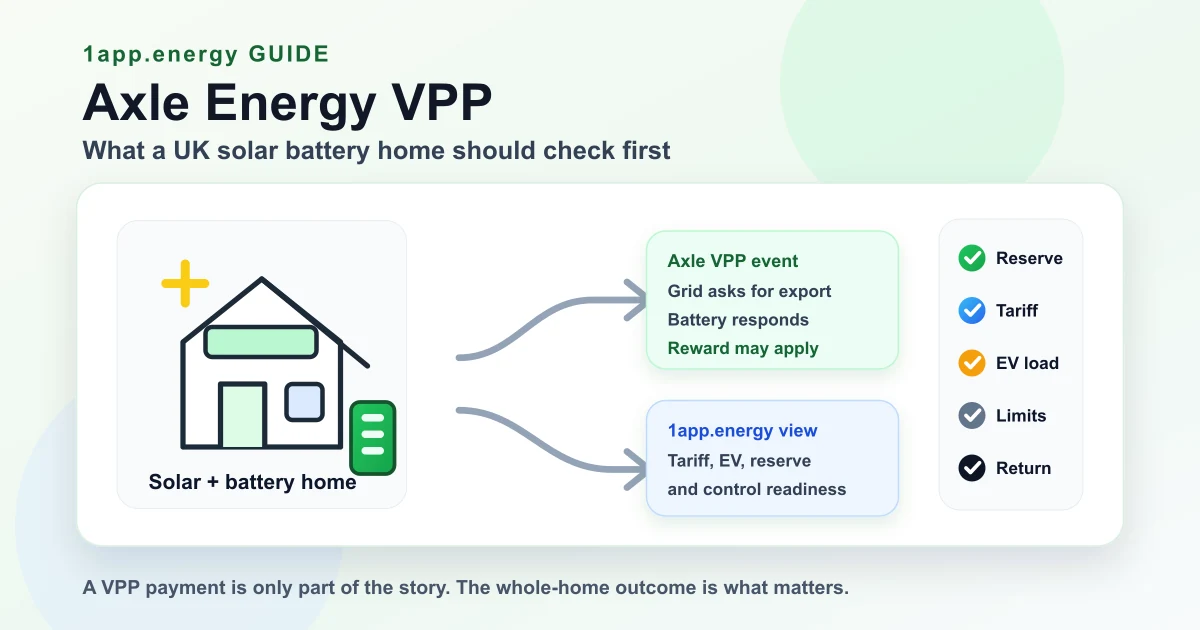
If you searched for Axel Energy VPP, the company spelling you want is Axle Energy.
Axle Energy gives eligible UK home battery owners a way to support the grid during short demand events. When an event runs, the battery can export stored energy to the grid and the homeowner can earn a reward for the energy sent out.
That can be useful, especially for homes that already have a battery sitting ready for evening use. It also adds another control layer to the home, so it is worth understanding what Axle does, which battery brands Axle lists, what Solis owners should check, and how the VPP fits beside your tariff, high-load appliances and normal inverter settings.
The quick version
Axle's public Grid Services page describes a beta VPP for battery owners. The page says eligible homes can earn £1/kWh during grid stress periods, with a minimum £10/month guarantee, while Axle dispatches the battery during brief events. Because Axle labels the programme as beta, check Axle's live page and terms before you rely on those numbers.
Axle's page says you need:
- a compatible battery;
- a smart meter;
- a battery connection Axle can use;
- tariff information so Axle can understand the cost side.
The important question is not only "can I earn from a VPP?"
The better question is:
If Axle moves my battery for a grid event, will the rest of my home still make sense afterwards?
That means checking eligibility, tariff, export limits, battery reserve, high-load timing and who owns inverter control during the event.
What is a VPP?
A virtual power plant, usually shortened to VPP, groups lots of smaller energy assets so they can act like one larger grid resource.
In a home battery context, that usually means many individual batteries can be coordinated during short periods when the electricity system needs help. Instead of one large power station responding, thousands of homes may charge, hold, reduce demand or export.
For the homeowner, the idea is simple:
- the battery is already installed;
- the grid sometimes needs flexible energy;
- a VPP provider coordinates the event;
- the customer may receive a reward if their battery contributes.
That is why VPPs are attractive. They can turn a home battery from a private household asset into something that also supports the wider grid.
The important customer detail is that a VPP needs some level of battery access. That does not automatically make it unsafe, but it does mean the home now has another control layer.
How Axle Energy VPP works
Most of the time, your battery carries on serving your home. It may charge from solar, hold energy for the evening, charge during a cheap tariff window, or follow whatever schedule you normally use.
During an Axle event, Axle can dispatch the battery to export energy to the grid. Axle's public page says customers keep control of the battery outside grid events, while Axle dispatches during the event window.
The signup flow is also worth noting. Axle's signup page says it asks for:
- meter details from a recent electricity bill;
- a battery connection so Axle can read data and adjust settings;
- tariff information so costs can be analysed.
That tells you what kind of service this is. Axle is not just a newsletter or a manual reminder. It needs enough access to understand the home, connect to the battery, and dispatch the battery during grid events.
Which battery brands does Axle list?
Axle's public VPP page lists these battery brands under "Works With":
| Battery brand listed by Axle | What to check before assuming eligibility |
|---|---|
| Sigenergy | Exact battery and inverter setup, firmware, region and Axle connection support |
| FOX ESS | Exact inverter, battery model, account access and export-limit setup |
| GivEnergy | Battery generation, account connection, tariff and smart meter compatibility |
| SolaX | Battery/inverter pairing, SolaXCloud access and local export settings |
| Solis | Compatible Solis hybrid inverter and battery setup, firmware and control mode |
| SolarEdge | Battery compatibility, inverter setup, meter connection and export limits |
Axle also says more brands are coming and lets customers request another brand.
This list is a starting point, not a guarantee that every model from every listed brand will be accepted. A brand can be listed while an individual home still fails eligibility because of model, firmware, account access, smart meter, tariff, export limits or local setup.
What makes a home eligible?
A home battery VPP needs more than a battery brand logo.
Before joining Axle, check four things:
- Battery brand and model. The brand should be listed or accepted by Axle, and the exact model still needs to work with Axle's connection method.
- Smart meter. Axle says a smart meter is needed and will be checked during signup.
- Battery connection. Axle needs to connect to the battery so it can read data and adjust settings.
- Tariff and export position. Axle asks for tariff information and the home still needs to respect export limits, supplier rules and any DNO paperwork.
If one of those pieces is missing, the home may not be ready even if the battery brand is on the public list.
Why this matters for 1app.energy customers
1app.energy is built around one customer problem: homes with solar, batteries, tariffs and connected devices often behave like separate systems.
An inverter app can show battery data. A supplier app can show tariff data. Other devices may add their own schedules. A VPP app or service can dispatch the battery for grid events.
The customer still needs to understand the whole home:
- Did the battery export because the tariff made sense, or because a VPP event happened?
- Was the battery still above the reserve floor afterwards?
- Did the home import later at a worse rate?
- Was the home running a large load at the same time?
- Did the inverter return to its normal schedule?
- Did the dashboard explain the event clearly?
That is exactly the kind of coordination problem covered in home energy dashboard source of truth: what to check. A dashboard is only trustworthy when each number comes from the right source and the customer can tell which system owned the action.
If you already use 1app.energy, Axle should be thought of as an external battery-dispatch layer, not as a replacement for whole-home visibility.
The main risk: two systems trying to optimise one battery
Home batteries are not hard to move. They are hard to move at the right time for the whole home.
A normal day might include:
- overnight cheap-rate charging;
- a morning reserve target;
- solar charging through the day;
- evening home use;
- high-load appliances;
- export opportunities;
- a VPP event.
Each item can be sensible on its own. The problem starts when two systems make battery decisions without sharing the same context.
For example, Axle may want the battery to export during a grid event. That may be good for a reward. But your home may also need to preserve battery for the evening, heating, cooking or another high-load period. If the battery exports too much and then the home imports later at a higher rate, the headline payment is not the whole story.
This is the same principle behind home battery export checks before selling stored energy. Battery export should be an evidence-based decision, not a reaction to one attractive event or one attractive rate.
If you have a Solis battery
Solis owners are one of the clearest audiences for this topic because Axle has published a Solis partnership announcement. Axle says compatible Solis hybrid inverter and battery systems can enrol in its VPP, and that customers can take part without changing energy supplier or switching tariff.
That is useful news for a Solis home, but it still needs a careful setup check.
If you have a Solis hybrid inverter and battery, start here:
- Check the exact Solis setup. "Solis" on a public compatibility list is not the same as your exact inverter, battery, firmware and account setup being ready.
- Check your smart meter. Axle says the smart meter is checked during signup. If the meter connection is not suitable, the VPP may not work for your home.
- Check how Axle will connect. Axle says it needs a battery connection so it can read data and adjust settings. Make sure you understand which account or app access is being used.
- Know the normal Solis mode. Before the first event, note whether your inverter normally uses self-use, scheduled charge, time-of-use, backup, export or another mode.
- Check the reserve floor. A VPP event should not leave the home short of battery for the evening, heating, cooking or other high-load periods.
- Check export limits. If the site has a DNO/export-limitation setup, the VPP behaviour still needs to sit inside that limit.
- Check what happens after the event. The useful result is not only the export payment. The inverter should return to a sensible state for the rest of the day.
For a 1app.energy Solis home, the extra point is avoiding two apps trying to move the battery at the same time. If Axle is dispatching the battery during a recorded event window, 1app.energy should not also try to charge or discharge the battery during that same window. The cleaner pattern is: Axle runs the VPP event, 1app.energy keeps monitoring the home, and you review the outcome afterwards.
For broader Solis context, read the Solis software gap guide. It explains why visibility, readiness and verified control are separate layers.
High loads during an event can reduce the credit
During an Axle event, the reward depends on how much energy is exported to the grid during the event window.
That means high home usage matters. If the home starts using a lot of power at the same time, more of the battery output may be used inside the home and less may reach the grid. The result can be a lower Axle credit because the exported kWh is lower.
That could be an EV charge, an immersion heater, a heat pump, cooking, or another large load. The practical rule is simple: avoid starting large loads during the Axle event window unless you deliberately want the energy used by the home instead of exported.
The event can still be useful, but judge it by the exported energy and the whole-home result, not just the advertised event rate.
Check the export and paperwork side
Any battery export service sits inside the physical and paperwork limits of the property.
For UK solar and battery homes, that can include:
- G98 or G99 connection context;
- G100 export-limitation arrangements;
- inverter export settings;
- installer handover limits;
- site-specific DNO approval;
- battery warranty and operating limits;
- tariff and export payment rules.
A VPP should not be used as a shortcut around those limits. If the home has an export cap, the control setup must respect it.
If the DNO side is unclear, read G98, G99 and G100 forms: UK solar and battery DNO guide before changing export behaviour.
How 1app.energy fits beside Axle
The cleanest way to think about the two products is:
- Axle Energy VPP: a third-party grid-services route for eligible batteries.
- 1app.energy: a customer-facing app layer for supported solar, battery, tariff and connected-home energy behaviour.
1app.energy is not trying to be a VPP in this article. It helps supported homes understand battery behaviour, tariff timing, dashboard values and smart-control readiness.
For supported Solis, Zappi, Octopus and beta LuxPowerTek homes, 1app.energy can help answer the questions that matter around a VPP event:
- What did the battery do before and after the event?
- Was the home importing later?
- Was a large home load running during the event?
- Was the battery below the reserve floor?
- Did the tariff window change the outcome?
- Was the latest inverter data fresh enough to trust?
- Is Smart Control enabled, pending, or unavailable for this setup?
Where supported, verified and customer-enabled, 1app.energy Smart Control can help coordinate battery behaviour around tariffs and home demand. But if Axle is dispatching the battery during a recorded event window, 1app.energy keeps monitoring the home and avoids sending battery charge or discharge controls during that window.
The 1app.energy Smart Control mode guide is the best next read if you are choosing between Autopilot, Home First and Time-based Control.
If you already have Axle events to record, read how to track Axle Energy credits in 1app.energy. That product guide shows the Dispatch Program settings, Axle Energy report and daily cost view.
What customers should do before joining Axle
Use this checklist before signing up for any VPP service, including Axle:
1. Confirm eligibility from the VPP provider
Check the live Axle page and terms for your exact battery brand, model, market, payment terms, smart meter requirement and tariff handling. Do not rely on an old social post or a neighbour's installation.
2. Take a screenshot of your current inverter settings
Before a first event, record the existing mode, schedule, charge windows, export settings and reserve floor. This gives you something to compare after the event.
3. Decide who owns battery control
If Axle is dispatching the battery during events, avoid also asking another app to charge or discharge the battery at the same time.
4. Protect the reserve floor
Your battery is not spare energy by default. It may be protecting the home for evening use, heating, cooking, or a customer-chosen backup level.
5. Check the next import window
If a VPP event empties part of the battery, ask when it can refill and at what cost. A reward is less useful if it causes expensive import later.
6. Avoid large loads during the event
Large loads can change the result. If the home is using a lot of power during the Axle window, less battery energy may export to the grid and the Axle credit can be lower.
7. Review the first event afterwards
Look at the battery state, import/export, home load and tariff context after the first event. If something did not return to normal, fix that before treating future events as routine.
If Axle looks right for your home after the checks above, you can use our referral link when you start the Axle Energy VPP signup:
Start Axle signupReferral note: this opens Axle's signup flow. Using it may support 1app.energy through Axle's referral programme, while Axle's eligibility, payment and referral terms still apply.
What installers should explain
VPPs can be a useful customer conversation, especially as more homes install batteries.
The installer handover should still be careful:
- which battery and inverter model is installed;
- what export limit applies;
- what operating mode the inverter normally uses;
- what reserve floor is sensible for the home;
- whether the customer has high-load appliances that may run during event windows;
- whether a third-party VPP can safely dispatch the battery;
- what the customer should check after the first event.
For installers who already recommend 1app.energy, the message is simple:
Axle may create an extra revenue route for eligible batteries. 1app.energy helps the customer understand the whole-home result.
That is stronger than pretending every control layer is the same thing.
Common questions about Axle Energy VPP and 1app.energy
Is Axle Energy the same as 1app.energy?
No. Axle Energy is a third-party energy flexibility company. Its VPP programme is about eligible batteries supporting the grid during events. 1app.energy is a customer-facing SaaS layer for supported solar, battery, tariff and connected-home energy behaviour.
Which battery companies does Axle list?
Axle's public VPP page lists Sigenergy, FOX ESS, GivEnergy, SolaX, Solis and SolarEdge. Axle also says more brands are coming and lets customers request another brand.
Treat that as a brand-level starting point. You still need Axle to check the exact battery, inverter, account connection, smart meter and tariff setup for your home.
What do I need before joining Axle?
Axle says you need a compatible battery and a smart meter. Its signup flow also asks for meter details from a recent bill, a battery connection and tariff information.
Before signing up, also check your export limit, normal battery mode, reserve floor, high-load timing and whether another app is already controlling the inverter.
Can I connect Axle Energy directly to 1app.energy?
No. You still join Axle through Axle, and Axle remains the place to check whether your home can take part, what gets paid and when.
For enrolled homes, the Dispatch Program in 1app.energy can record Axle event windows, including manually or by pasting the Axle email, then show separate Axle reporting inside 1app.energy. The step-by-step workflow is covered in how to track Axle Energy credits in 1app.energy.
Can 1app.energy show my Axle Energy credit?
Yes, where the Axle Dispatch Program is enabled and event windows are recorded in 1app.energy. Use it as a clear in-app estimate from recorded windows and measured export, not as your Axle payout record.
For screenshots and the full workflow, read how to track Axle Energy credits in 1app.energy.
Does Axle Energy work with Solis batteries?
Axle has published a Solis partnership announcement and its public VPP page lists Solis among compatible battery brands. Axle says compatible Solis hybrid inverter and battery systems can enrol without changing supplier or tariff.
That does not mean every Solis home is automatically ready. Check the exact inverter, battery, firmware, smart meter, account access, export limit and normal Solis control mode.
Will joining a VPP hurt my battery savings?
It depends on the home. A grid event payment can be useful, but the full result depends on reserve, replacement import cost, export limits, tariff windows, battery losses and any large load running during the event.
Should I turn off 1app.energy Smart Control during Axle events?
That depends on your setup. The safe principle is to avoid two apps trying to move the battery at the same time. For recorded Axle dispatch windows, 1app.energy is designed to keep monitoring the home while avoiding battery charge or discharge controls during the active window.
Is a VPP the same as Octopus Saving Sessions?
No. They are related ideas because both reward flexible behaviour, but they are not the same product. Axle's FAQ has a dedicated question on this distinction, and Octopus has its own Saving Sessions and Power Up/Power Down flows. We explain the Octopus side in Octopus Power Up and Power Down: what it means for UK homes.
What should I check after my first VPP event?
Check battery state of charge, inverter mode, import/export, home load, tariff rate, reserve floor and whether the normal schedule resumed. If anything looks wrong, pause before assuming the next event will behave the same way.
Final thought
Axle Energy VPP is worth understanding because UK home batteries are becoming more than backup boxes or solar-storage devices. They are becoming flexible grid assets.
That is good news, but it makes clarity more important.
If your battery is controlled by a VPP, your home still needs a clear view of tariff, home load, reserve, export limits and daily cost. A payment for one event is only part of the story. The whole-home outcome is what matters.
Visit 1app.energy to start early-access onboarding and see whether your solar, battery, tariff and connected-home setup is a good fit for supported whole-home visibility and Smart Control.
Does this sound like your home?
Your setup might already qualify.
Tell us which devices and tariff you are on. We review every request and invite in order of fit, not sign-up date.