Intelligent Octopus Flux: what battery owners should check
What Intelligent Octopus Flux does, which battery brands Octopus lists, what control you hand over, and what Solis and LuxPowerTek owners can do instead.
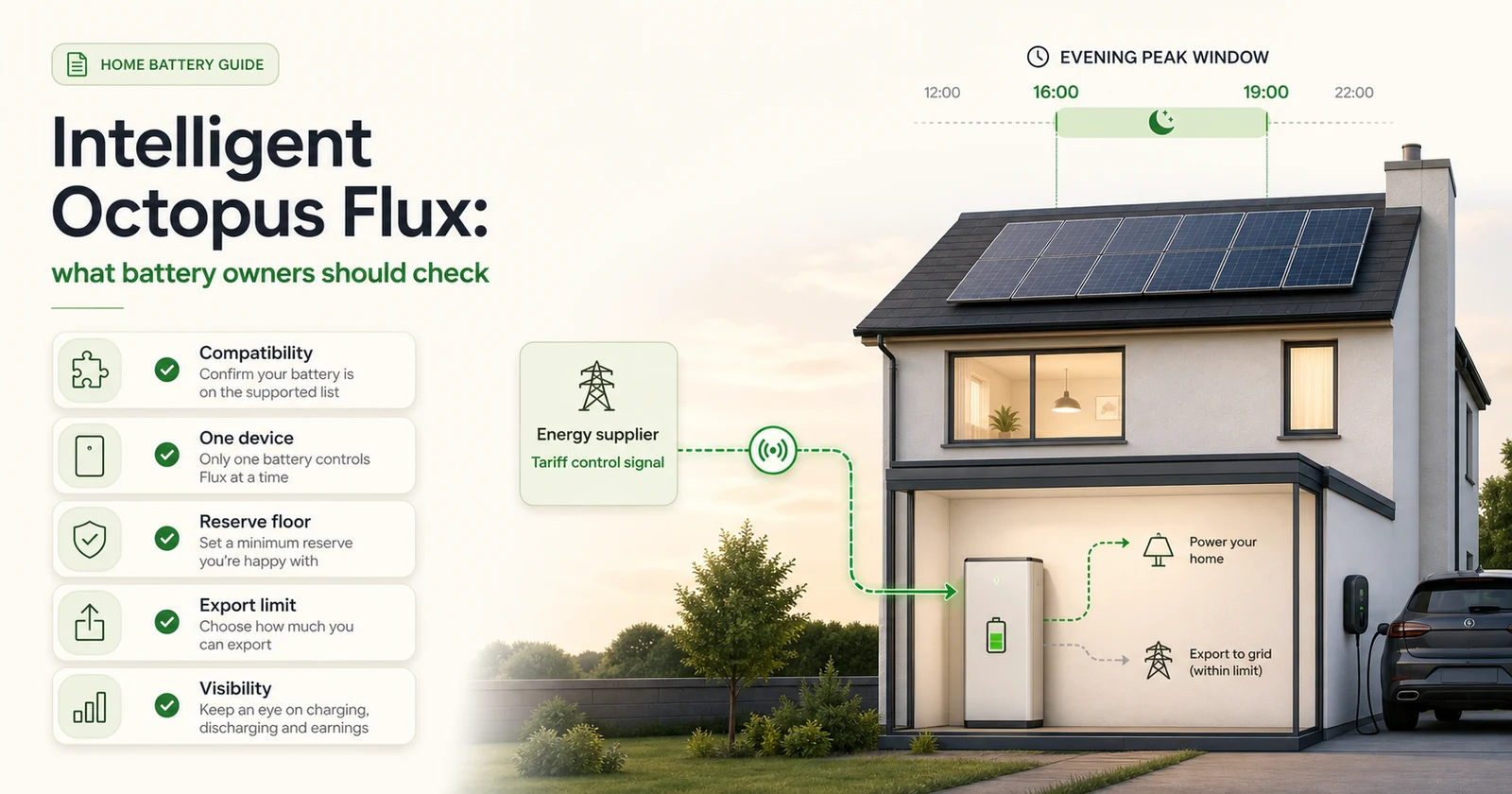
Octopus runs two Flux tariffs for homes with solar panels and a battery. Standard Octopus Flux gives you structured import and export windows and leaves the battery scheduling to you. Intelligent Octopus Flux goes further: you connect a compatible battery and Octopus takes over the charging and discharging.
For some homes, that automation is the reason to look at the product. But "compatible" is doing a lot of work in that sentence, and handing over control changes how your whole home behaves.
This guide explains what Intelligent Octopus Flux does, which battery brands Octopus lists, what you give up, and what to check before connecting. It also covers the question many homeowners land on last: what to do when your inverter is not on the list.
Intelligent Octopus Flux is a control decision first and a rate decision second. Decide who runs your battery before you compare unit rates.
The quick version: Intelligent Octopus Flux in 2026
- Standard Octopus Flux pairs a cheap import window around 02:00 to 05:00 with a 16:00 to 19:00 peak window for both import and export, and you schedule the battery yourself. The time windows are fixed, but the tariff itself is flexible, so rates can change.
- As of June 2026, Octopus's Flux page shows standard Flux as temporarily unavailable for new sign-ups. If your battery is not compatible with Intelligent Flux, do not assume standard Flux is an immediate fallback.
- On Intelligent Octopus Flux, Octopus pairs with a compatible battery and schedules charge and discharge for you, including discharge or export during the 16:00 to 19:00 peak window.
- Octopus describes Intelligent Flux import rates as lower than standard Flux, with flexible prices that can move with wholesale energy costs.
- Compatibility is brand-specific, and Octopus's public pages do not all show the same list. Treat the in-account eligibility check as the source of truth. Solis and LuxPowerTek are not on the public lists as of June 2026.
- Octopus's FAQ says you can register one device per property, so the battery route and an EV charger route compete for the same slot.
What Intelligent Octopus Flux actually does
Standard Flux is a price plan. Intelligent Octopus Flux is a price plan plus a control service.
Once your battery passes the eligibility check and connects, Octopus states in its Intelligent Flux FAQ that it will take control of scheduling charging and discharging at times that are clean and green. In practice that means Octopus decides when your battery imports cheaper energy, when it holds, and when it discharges or exports during the evening peak.
Octopus markets the result with an "up to £300" profit claim. Its FAQ explains that between June 2024 and May 2025, 34% of Intelligent Octopus Flux customers paid less for imported energy than they earned from export, and the top 12% offset their full electricity bill and standing charge with £314 or more on top. Treat that as Octopus's own evidence, not a promise for every home. Your outcome depends on battery size, solar generation, home load, region and wholesale prices.
The important mental shift is this: your inverter app schedules stop being the decision-maker. The tariff is no longer something your battery reacts to. The tariff operator is running the battery.
Octopus Flux vs Intelligent Octopus Flux
The two products share a shape: cheap overnight import, expensive evening window, export paid at its best around 16:00 to 19:00.
They differ in who does the work:
- Standard Flux: fixed time windows, flexible rates, you keep full control of battery scheduling, any solar and battery brand can apply, and you need the paperwork (MCS or FlexiOrb certificate, export MPAN, smart meter on half-hourly readings). As of June 2026 it is paused for new sign-ups on Octopus's public page.
- Intelligent Octopus Flux: Octopus controls the battery, only approved battery integrations qualify, import rates are described as lower than standard Flux, and the 16:00 to 19:00 flux period is still the key peak window. The rates are flexible, so check the live quote for your region.
If you came to this comparison from the EV side, the same control trade-off exists on the EV tariffs, covered in Octopus Go vs Intelligent Octopus Go for battery homes.
Which batteries work with Intelligent Octopus Flux?
This is where most homes find out whether the decision is even theirs to make.
As of June 2026, Octopus's Intelligent Octopus Flux page shows an eligibility picker with brands including AlphaESS, Ecoflow, Enphase, Fox ESS, GivEnergy, Hanchu ESS, Huawei, Sigenergy, SolarEdge and SunPower. Octopus's FAQ says the current integrations are GivEnergy, Enphase, SolarEdge and Tesla Powerwall, with Hanchu ESS listed as coming soon.
Those public pages are not identical. That is the important point for homeowners: the in-account eligibility check is the source of truth, not a marketing page, a forum post or a screenshot.
Two widely installed UK brands are absent from both lists: Solis and LuxPowerTek.
If your exact battery cannot pass Octopus's live eligibility check, Intelligent Octopus Flux is not available to you today. As of June 2026, standard Flux is also paused for new sign-ups, so the fallback is not as simple as "use normal Flux instead".
Octopus lets you register interest for unlisted brands, so the list can grow. But "can grow" is not a plan for this winter.
What you hand over when Octopus controls the battery
Joining Intelligent Octopus Flux means accepting a few conditions that are easy to miss on the sign-up page.
Scheduling control moves to Octopus. Your own charge windows, discharge windows and export plans stop being the source of truth. If you have spent time tuning a schedule around your home's habits, that work is replaced by Octopus's optimisation.
Octopus needs ongoing control access. The smart tariff terms say Octopus needs control access to your battery while you remain eligible. They also give Octopus exclusive rights for demand response services from that low-carbon technology while you are on the tariff. Do not stack another battery VPP or control scheme on top unless the terms and both providers clearly allow it.
Disconnecting has a cost. Octopus's FAQ says you can disconnect the battery temporarily through the app. The smart tariff terms say that if you do not have active authorisation for a supported battery for more than 30 days, you will no longer be eligible for Intelligent Octopus Flux.
One device per property. Octopus currently allows one registered device per property on its intelligent products. A home with a compatible battery and a compatible EV charger has to choose which one Octopus controls. If the EV is the bigger load, the maths may favour the EV route instead, and that interaction is exactly what the Intelligent Octopus Go Charge Cap guide walks through.
One connected battery. Octopus's FAQ also says you cannot connect more than one battery yet. If you have a second battery that is not linked with the first, expect to control that second battery yourself.
Your export arrangement changes. Intelligent Octopus Flux is a combined import and export tariff. Octopus's terms say you cannot be on another electricity tariff at the same time, except Octopus Power Pack export, and FiT export payments are replaced by Intelligent Octopus Flux export payments. If you receive Feed-in Tariff payments, check the export side carefully before switching.
Export limits still apply. Octopus optimising your export does not change your DNO export limit or your installation paperwork. The checks in home battery export checks before selling stored energy apply just as much when a supplier is pressing the buttons.
Your reserve expectations need stating. A battery that is being optimised for grid value will run cycles you did not plan. Octopus's FAQ says its controlled batteries were set to a 20% minimum as of 11 October 2023, and that this may vary. Know what floor you expect the battery to hold for backup or evening cover, and confirm how the current product treats it before the first controlled week. The thinking in battery reserve floor: what UK solar homes should check is a good starting point.
This is the same trust question raised by third-party dispatch services, covered in Axle Energy VPP: what home battery owners should check: two systems should never be trying to optimise one battery at the same time.
What to check before joining Intelligent Octopus Flux
A short pre-flight list, in the order that saves the most time:
- Run the live eligibility check. Confirm your exact battery brand and model in your Octopus account flow, not against a screenshot or a forum thread.
- Confirm the export side. You need import and export smart metering, an export arrangement with Octopus, and the installation paperwork behind it, such as MCS, FlexiOrb or DNO evidence where requested. If that is unclear, start with the DNO basics before the tariff.
- Check existing FiT or export payments. Do not move a legacy export arrangement by accident. Make sure you understand what happens to deemed export, SEG or FiT export payments before switching.
- Decide the one-device question. Battery control or EV charger control. Write down which loads matter most in your home before Octopus's app asks you to pick.
- Record your current settings. Inverter mode, charge windows, reserve floor, export caps. If you later leave the product, you will want to restore a known-good state.
- Plan your visibility. Decide how you will see what the battery actually did each day: what charged it, what it exported, and what the home imported at peak. A controlled battery without visibility is a black box with a unit rate.
If your inverter is not on the list: Solis, LuxPowerTek and others
A large share of UK solar and battery homes run inverters that Intelligent Octopus Flux does not list, with Solis among the most common.
For those homes, as of June 2026 the practical position is:
- Intelligent Octopus Flux: not available for your setup today.
- Standard Flux: paused for new customers.
- Agile, Go, Intelligent Octopus Go and fixed tariffs: may still be available depending on eligibility and current terms, but they assume you bring your own battery coordination.
That last line is the real gap. These tariff routes still need the battery to be coordinated, but nobody is running the battery for you.
This is the gap 1app.energy works in. For supported Solis, Zappi and Octopus homes, with LuxPowerTek in beta, 1app.energy reads the tariff, the battery, solar and EV charging in one place, and where supported, verified and customer-enabled, Smart Control can schedule the battery around the tariff for you. How that looks on a real setup is covered in running a Solis inverter on Octopus Agile with 1app.energy.
In other words: if Octopus cannot control your battery, that does not mean your battery has to stay uncoordinated.
How 1app.energy fits beside Intelligent Octopus Flux
Honest boundaries first: 1app.energy does not control the battery brands on Octopus's Intelligent Flux list today. If you have a GivEnergy or Tesla system and you join Intelligent Flux, Octopus runs that battery and 1app.energy is not the right control layer for it.
The fit is for the homes on the other side of the list:
- Solis or LuxPowerTek battery, no Intelligent Flux access: 1app.energy gives the home one view of tariff, battery, solar and EV behaviour, and tariff-aware Smart Control where supported and customer-enabled.
- Mixed homes (supported battery plus Zappi EV charger): the one-device rule on Octopus's side does not limit what you can see in 1app.energy. Battery, EV sessions and tariff windows sit in one daily picture.
- Homes choosing between tariff routes: before committing, it helps to see your actual evening import, solar surplus and EV load in one place for a couple of weeks. That data usually makes the Flux-versus-Go-versus-Agile question answer itself.
Common questions about Intelligent Octopus Flux
Is standard Octopus Flux still available for new customers?
As of June 2026, Octopus's Flux page describes the standard tariff as temporarily unavailable for new sign-ups, citing volatile energy prices. Check the live Octopus page and your own account terms before planning around it.
Which batteries are compatible with Intelligent Octopus Flux?
Octopus's product page eligibility picker lists brands including AlphaESS, Ecoflow, Enphase, Fox ESS, GivEnergy, Hanchu ESS, Huawei, Sigenergy, SolarEdge and SunPower. Its FAQ says current integrations are GivEnergy, Enphase, SolarEdge and Tesla Powerwall, with Hanchu ESS coming soon. Because those pages differ, the eligibility check inside your Octopus account is the source of truth. Solis and LuxPowerTek are not listed as of June 2026.
Does Octopus control my battery on Intelligent Octopus Flux?
Yes. Octopus states that once connected it takes control of scheduling charging and discharging. You can disconnect temporarily in the app, but the smart tariff terms say a supported battery without active authorisation for more than 30 days means you are no longer eligible for the product.
Can I have Intelligent Octopus Flux and Intelligent Octopus Go together?
No. Octopus's FAQ says you can register one device per property, so a home chooses between battery control and EV charger control. Homes with both should compare which load moves more money before picking.
Does Intelligent Octopus Flux work with Solis inverters?
Not as of June 2026. Solis is not on Octopus's public compatibility lists. Solis homes can register interest with Octopus, and in the meantime can run tariff-aware battery coordination themselves on Agile, Go, Intelligent Octopus Go or another suitable tariff, which is what 1app.energy provides for supported setups.
What export rate do I get during the 16:00 to 19:00 peak?
Flux products price the 16:00 to 19:00 window as the premium period. Octopus says Intelligent Octopus Flux import and export rates match, with high import and export rates in the peak period and lower rates outside it. Check your live Octopus quote rather than relying on a figure from an article, including this one.
Final thought on Intelligent Octopus Flux
Intelligent Octopus Flux is a specific product for the brands it supports. If your battery is eligible, your main job is to go in with clear expectations: know the one-device rule, understand what happens to your export arrangement, state your reserve expectations, keep your paperwork straight, and keep some independent view of what the battery is doing.
If your battery is not eligible, you are not locked out of smart behaviour. You are just the one who has to choose the coordination layer.
Visit 1app.energy/signup to check whether your Solis, Zappi and Octopus setup is supported and start signup.
Does this sound like your home?
Your setup might already qualify.
Tell us which devices and tariff you are on. We review every request and invite in order of fit, not sign-up date.